
When to Go to the Emergency Room vs. Urgent Care: Signs, Symptoms & Safety Tips
When to Go to the Emergency Room vs. Urgent Care: Signs, Symptoms & Safety Tips
This information is meant to help guide healthcare decisions. If you are experiencing life-threatening symptoms, seek emergency medical care immediately.
We’ve all been there, you’re feeling unwell, something just isn’t right, and you’re unsure where to turn. In that moment, one question weighs heavily: Should I go to the ER, or is urgent care enough?
It’s a stressful decision to make, especially in the middle of a health scare. That’s why we want to take a moment to clearly explain the difference, so when the time comes, you’ll feel confident about where to go and which type of care is best for your situation.
Because the truth is, choosing the right facility can save you more than time and money, it can save your life. We’re here to help you make that choice with clarity and peace of mind.
Understanding Emergency Care vs. Urgent Care
Urgent care clinics serve an important purpose. They’re convenient for minor health issues like sore throats, ear infections, or a suspected urinary tract infection (UTI). You can walk in, get treated quickly, and be on your way. For known, non-emergent issues, that’s often enough.
But when your symptoms are unfamiliar, serious, or worsening fast, that’s when the emergency room (ER) is the better, and safer, choice.
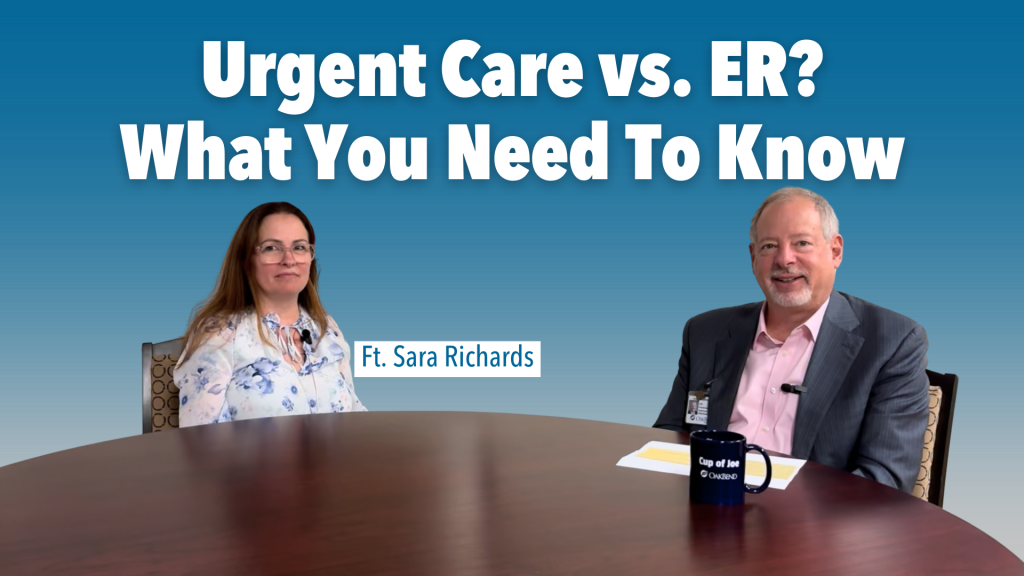
As Sara Richards, Assistant Vice President of Nursing, explains, “You don’t necessarily get the same services in an urgent care that you would in an emergency room… It may not even be a doctor. It could be a nurse practitioner.”
At an urgent care clinic, your care may be overseen by a nurse practitioner or physician assistant. While skilled in general medicine, they may not have experience with emergency situations. Supporting staff could include medical assistants, whose training typically includes a high school diploma and less than a year of post-secondary certification.
In a hospital emergency room, however, your care team includes board-certified emergency physicians and registered nurses trained in critical care. As Sara notes, “We’re taught how to critically think… just because I have a physician’s order does not necessarily mean that I blindly carry it out. I have to know why I’m giving what I’m giving.”
It is also important to consider that these nurses and doctors have years of education, certifications in Advanced Cardiovascular Life Support (ACLS), and the authority to act quickly in life-threatening situations.
What About Freestanding Emergency Rooms?
Freestanding emergency departments offer quicker access for some and are often conveniently located. Many have experienced staff, but there are limitations. As Sara puts it, “If you can make it to a hospital that has all of the services that you may need, I would go there.”
These centers are not connected to hospitals, meaning if you need to be admitted, they’ll have to transfer you. That includes coordinating ambulance transportation and receiving approval from another hospital, which can greatly delay your care.
Even when staffed with emergency-trained personnel, freestanding ERs often don’t have specialists on hand, such as cardiologists or neurologists, or access to in-hospital pharmacies and imaging.
When Symptoms Signal a Medical Emergency
Some emergencies are unmistakable like sudden trauma, severe bleeding, or loss of consciousness. But others aren’t as clear. That’s where many people hesitate and delay critical care.
Stroke Symptoms: Know BE-FAST
Strokes, for example, often go unrecognized because symptoms can be subtle in the beginning. Knowing the signs can make all the difference. A helpful way to remember stroke warning signs is the acronym BE-FAST:
- B – Balance: Sudden dizziness, trouble walking, or loss of coordination
- E – Eyes: Sudden vision loss or changes in one or both eyes
- F – Face: Facial drooping or uneven smile
- A – Arms: Weakness or numbness in one arm or leg
- S – Speech: Slurred speech, difficulty speaking, or drooling
- T – Time: Call 911 or get to the ER immediately
As Sara emphasized, “Time is tissue.” The faster we restore blood flow during a stroke or heart attack, the better your chances of recovery.
Heart Attack Symptoms: Especially in Women
Heart attacks can also look different, especially in women. Symptoms may include:
- persistent indigestion
- nausea
- jaw pain
- extreme fatigue
These signs can easily be mistaken for something less serious. In these situations Sara reminds us, “I would be concerned if the Tums that always works for me all of a sudden doesn’t. It doesn’t go away. I better check. I better get into, not a freestanding ER, go to an ER.”
Make the Right Call – Go to the Emergency Room
So how do you decide where to go? If you’re dealing with something truly minor, like a known, recurring illness you have been seeing a doctor for urgent care may be appropriate.
But here’s what we want you to remember: If you’re not absolutely sure it’s minor, don’t take the risk. Go to the ER.
Even injuries that seem minor, like a sprained ankle, can be more serious than they appear. As Sara shared, “Sometimes a sprain, or what you think is a sprain, is actually a broken ankle.” Without proper imaging and evaluation by specialists, a misdiagnosed injury could worsen over time. The ER has the tools and expertise to correctly assess and treat these injuries right away.
Any symptom that is new, sudden, intense, or just doesn’t feel right deserves to be checked out by a full emergency care team. You don’t have to be the expert in that moment, we’re here to be that for you.
Go straight to the emergency room if you experience:
- Chest pain or shortness of breath
- Sudden vision changes, confusion, or dizziness
- Slurred speech, facial drooping, or arm weakness
- Severe pain, trauma, or uncontrolled bleeding
- High fever with confusion, seizures, or fainting
- Anything that feels unfamiliar, extreme, or simply frightening
Don’t wait it out. Don’t second-guess. Let us evaluate you in the safest, most prepared setting possible.
Sara describes this best, “Something very small to you might be something very, very big that you just don’t know about, and it could save your life.”
When in doubt, choose the ER. Always.
24/7 Emergency Care with No Wait – We’re Here for You
Emergencies are never convenient, but they don’t have to be confusing. When something feels wrong, you deserve to know you’re in the best place with the best people to care for you.
As Sara said, “It takes the entire village… the entire hospital to do that.”
Our no-wait emergency department is here for you, 24 hours a day, 7 days a week, with highly trained professionals and access to the full range of hospital services, ready for whatever comes through our doors.
Because we’re not just healthcare providers. We’re your neighbors. Your community. And when every second counts, we’re right here, just as we always have been.